BIBLIO article by David Thompson
by Vincent O'Neil
BIBLIO article by David Thompson |
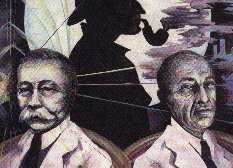
It would have been exciting to turn down the lights and touch fingertips with Sir Arthur Conan Doyle and Harry Price during a seance. Perhaps the two would use a planchette as part of their collaboration on the subject of the paranormal? If nothing else, it would be such a delight to sit at a table together with this duo of famous truth hunters! |
My mother - Marianne Foyster - was in a seance once with Price, and asked to be excused. I believe the atmosphere became far to intense for her. My mother enjoyed life, and wanted very much to live it to the fullest extent possible. She was not adverse to having fun, and to even playing pranks. Price would have smirked to learn she once put a sheet on a clothes line and yanked on it to scare someone staying with the Foysters at Borley Rectory. The seance, on the other hand, was just too close.
My mother and Price did not get along. She did not like the publicity he instigated. The ball he started rolling threatened to overcome us and sweep us away. Mom would have none of it. All my life, she tried to protect me from prying eyes and poking fingers. Their mutual distrust left with us to America, and even grew. Neither one trusted the other, yet they both had a great deal in common.
Both did not like to give up on anything. My mother enjoyed the limelight as much as Price. To their dying day, both lived with visions of ghosts in their heads. Both wanted so desperately to visit the "beyond," that both have been labeled as fakers. Both have been proven to exaggerate the details of stories they were telling as their audiences were held captive. Both may have been subject to the old adage, "we abhor in others what we cannot stand in ourselves."
My mother enjoyed the limelight as much as Price. She wanted to be just as famous, and even dreamed of becoming a popular author. But when it got personal, enough was enough! She stifled her dreams to protect me.
While it was fun to "play ghosts," the seance at Borley scared my mother. She was very mindful after that to make her spiritual investigations more casual. We were always careful in our home to not invite "tantrabobous" into our lives. She invented that moniker because she believed the devil could hear us talking and would take umbrage if we were not respectful. Her dream was to visit ghost towns in the American West, and she delighted in spooky stories. Yet, there was a line that was not to be crossed.
Price was more fervent. If only for the sake of his career, he lived with the hope of seeing the dead. I have often wondered if Price wasn't so caught up in his own fanaticism that he could not back down? Is it possible that some time during his checkered career, he decided ghost hunting was as flimsy an occupation as the spirits he was hunting? However, his two books on Borley, his magic lantern shows, his world-wide articles, and his radio broadcasts were bringing him fame and fortune. How to kill the goose that lays the golden egg? Besides, hope springs eternal in the heart of all ghost hunters.
Price gave a great deal of credence to table and wall tappings. He published the results of several seances in his writings, and many people have used those transcripts as part of their serious study of the beyond. It is unfortunate that Price and the others were not able to possess a copy of the mid-70s "Phillip" study in Toronto. Would any serious paranormal investigator give credence to tappings after learning Phillip was created in the minds of a handful of people? Phillip "talked" to them, moved tables for them, and even pouted after them if they left the room. Phillip had been created in the minds of the researchers - he had never really lived. The group concluded the energy of their combined efforts produced Phillip phenomena because they all wanted it to happen.
Of all the negative accusations thrown against Price, most revolved around Borley and some stunts he was involved in that were later proven faked. It is surprising more attention hasn't been paid to his story of the ghost girl, Rosalie.
Price called Rosalie, "The only real ghost I have ever met," in a May 1950 Coronet magazine article. Oddly enough, the story was only published two years after his death. This is strange, because if it were true, it would have brought him even more notoriety.
Price wrote, "It was my most thrilling experience in a lifetime of debunking spiritualist charlatans." Price recalled that in 1937 Rosalie appeared to him - in three dimensional form - several times in her London home. The girl had died of diphtheria at age six. Her appearances were always au natural, and she spoke out loud to those in attendance. "Her flesh felt warm," Price wrote. "I could distinctly hear her breathing." The reader could be excused for being a bit skeptical.
Spiritualism can be a synonym for emotionalism. If you want something badly enough - you experience it. Did Price want to see Rosalie so badly he actually believed he touched her? Or, was he so in tune with the other side, he was able to see and touch things mere mortals are excluded from experiencing?
Rosalie appeared to Price two years before Borley was destroyed by fire. She appeared to him precisely during his year-long of the empty rectory - 1937. If he was so in tune while visiting with Rosalie, why wouldn't he experience something - anything - of a similar nature during his intensive investigation of the rectory? The Borley ghosts were reported prior to his visits, and have been witnessed after. Depending on which legend you believe, there is more than one unhappy spirit wandering the paths of this remote village. If a person is in tune with one spirit in London, why would he not be in tune with several in Essex?
Granted, Price turned over most of the Borley investigation to others, but doesn't it make sense that if he touched the warm, breathing body of a deceased girl in London, he would rush to his car and race 60 miles to Essex while the experience was still fresh? Wouldn't such a visit spur the witness on to experience something similar at the most haunted house in England?!
Sir Arthur died a few years before Price came in personal contact with Rosalie. He died just before Borley was to become famous, and may not have known about the charges of fraud against Price. Would both men have stared into the other man's eyes looking for clues as they prepared for a joint seance? Both were members of the Society for Psychical Research and used to all manner of supposed paranormal events. This would be quite a meeting, indeed!
Although he never ceased being an agnostic, Sir Arthur became a believer in Spiritualism and even promoted it. He declared fakes were far less common than would be supposed. Would he welcome Price into his circle? Would Price have felt comfortable?
Whether from the touch of a ghost, or the tension between two dedicated spiritualists, the electricity the two would generate during a seance together would be something to behold!